Sugar in Breakfast Cereal: The Best and Worst Boxes, Ranked
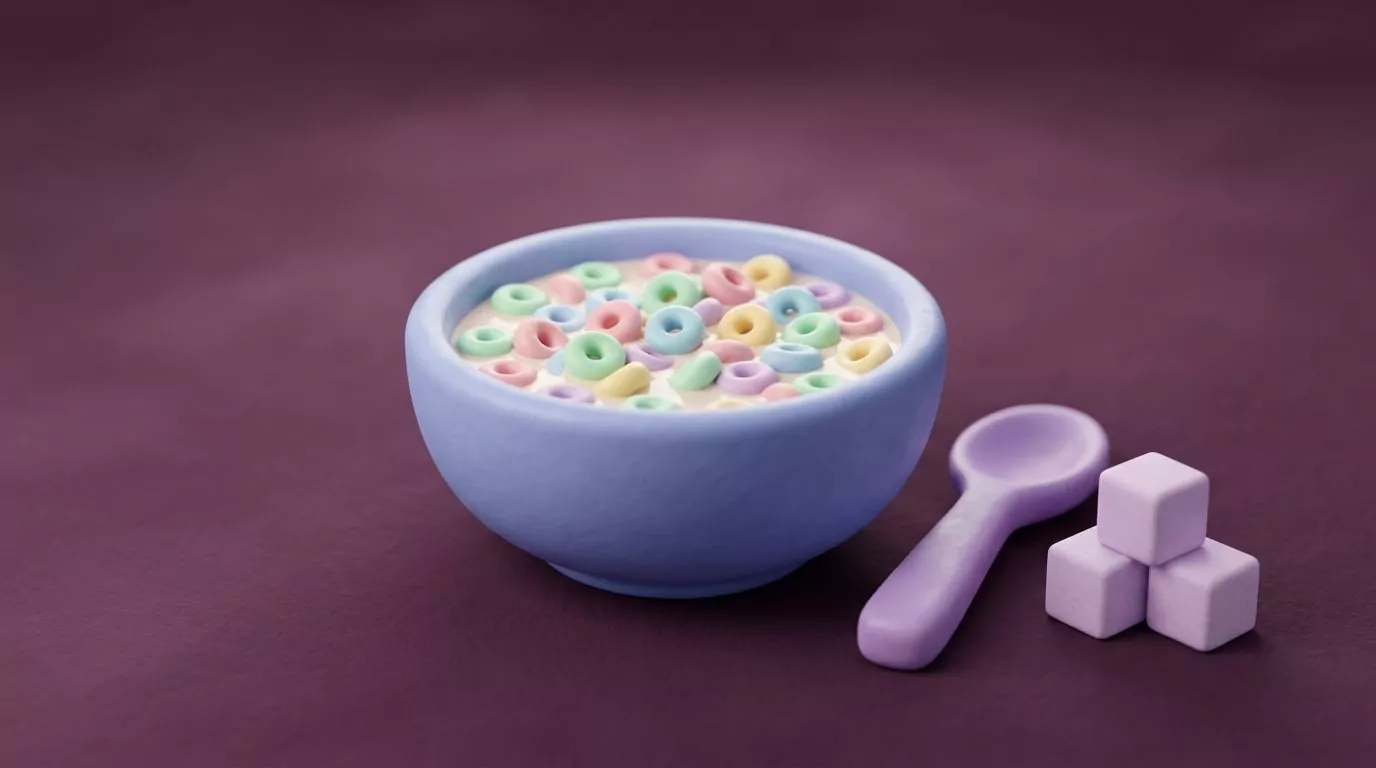
Most sugar in breakfast cereal hides behind a serving size nobody uses. A sweetened box carries about 12 grams of added sugar per label serving. Real bowls hold closer to 60 grams of cereal, which lifts one bowl to roughly 18 to 20 grams. That is 4.5 to 5 teaspoons, before you pour the milk.
That gap between the label and the bowl is the whole story. Every ranking you can find online reports grams per serving or grams per 100 grams. Almost nobody converts those numbers into teaspoons in the bowl you actually eat.
So that is what this guide does. Below you will find the highest and lowest sugar boxes on US shelves, ranked by what lands in a real bowl, plus a 10 second shelf test you can run with one thumb.
How much sugar is in a bowl of cereal, really
Two numbers decide the answer. The first is how much added sugar the cereal holds by weight. The second is how much cereal you pour.
Start with the easy conversion. One teaspoon of sugar weighs about 4 grams, and a sugar cube is about the same. The World Health Organization uses the same math when it says 50 grams of free sugars is about 12 level teaspoons a day.
So divide any grams figure by 4 and you get teaspoons. A 12 gram label serving is 3 teaspoons. A 20 gram bowl is 5 teaspoons.
The label serving is smaller than your bowl
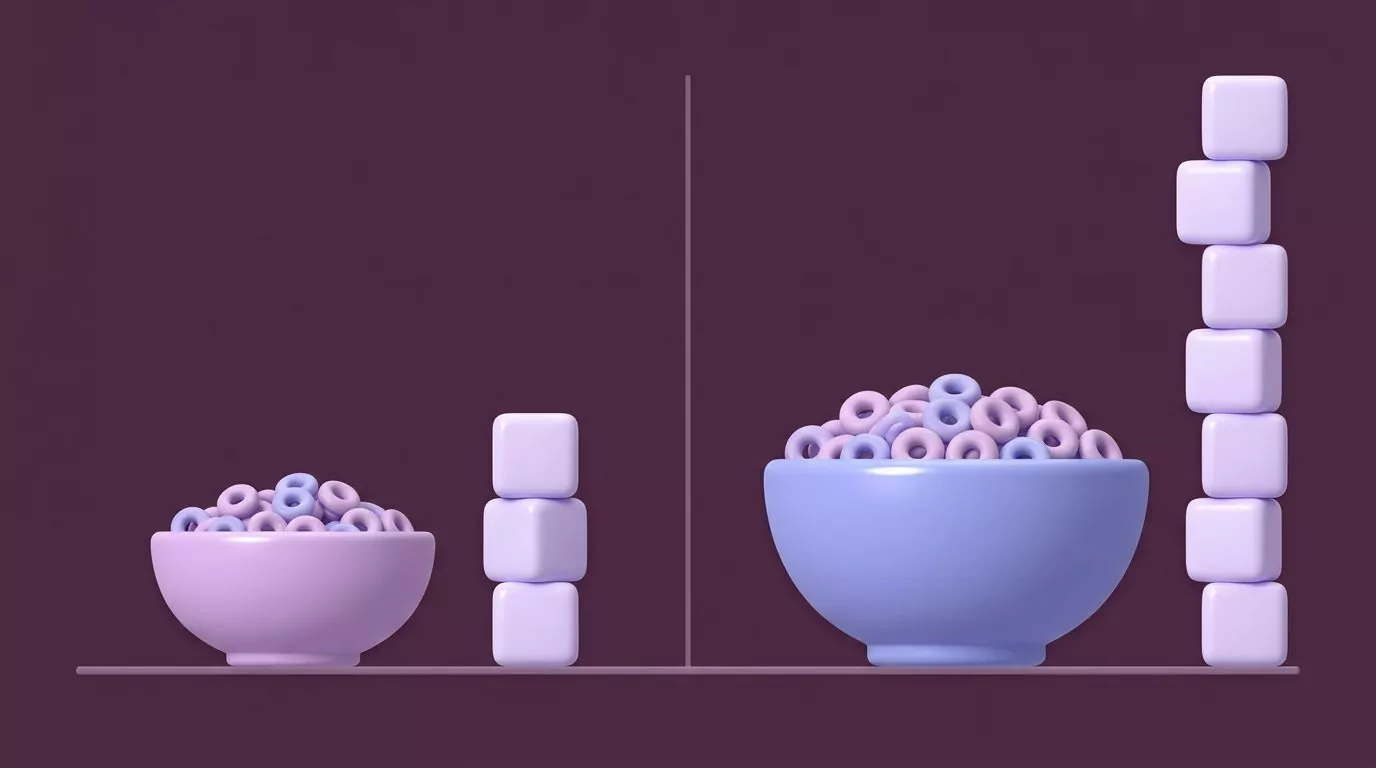
Here is where the numbers slip. Cereal makers set label servings between 30 and 41 grams for most sweetened boxes. A standard cereal bowl holds far more than that.
Pour without measuring and you land near 55 to 60 grams. That is roughly 1.5 to 2 times the label serving. Every sugar number on the box scales up with it.
Run the math on your own box
You only need three steps, and you can do them in the cereal aisle.
- Read the serving size in grams and the Added Sugars line on the Nutrition Facts panel.
- Divide the added sugars by the serving size, then multiply by 60. That is your real bowl.
- Divide that answer by 4 to get teaspoons.
If you would rather skip the arithmetic, the Sugar Grams to Teaspoons Converter turns any gram figure into teaspoons and sugar cubes in one step. It runs in the browser with no signup.
Keep two reference numbers in your head while you read the tables below. The American Heart Association suggests a daily added sugar ceiling of 6 teaspoons for women, or about 25 grams, and 9 teaspoons for men, or about 36 grams. The WHO suggests that dropping free sugars below 25 grams a day may bring extra benefit.
Sugar in breakfast cereal: the worst boxes, ranked
These are the highest sugar cereals on mainstream US shelves that we could check against current label data. Figures come from the Nutrition Facts panel and from USDA FoodData Central branded records.
The bowl column assumes 60 grams of dry cereal. The last column compares that bowl against a 25 gram daily limit.
This is deliberately not a top 10 cereals with most sugar list. Every box here was checked against a current label, and a shorter verified list beats a longer guessed one. Breakfast cereal sugar content moves whenever a recipe changes, so the method matters more than the ranking.
| Cereal | Label serving | Added sugar per serving | Added sugar per 100 g | Added sugar in a 60 g bowl | Teaspoons per bowl | Share of a 25 g day |
|---|---|---|---|---|---|---|
| Kellogg's Honey Smacks | 1 cup (36 g) | 18 g | 50.0 g | 30.0 g | 7.5 | 120% |
| Lucky Charms | 1 cup (36 g) | 12 g | 33.3 g | 20.0 g | 5.0 | 80% |
| Frosted Flakes | 1 cup (37 g) | 12 g | 32.4 g | 19.4 g | 4.9 | 78% |
| Reese's Puffs | 1 cup (39 g) | 12 g | 30.8 g | 18.5 g | 4.6 | 74% |
| Froot Loops | 1 1/3 cups (39 g) | 12 g | 30.8 g | 18.5 g | 4.6 | 74% |
| Cinnamon Toast Crunch | 1 cup (41 g) | 12 g | 29.3 g | 17.6 g | 4.4 | 70% |
One box stands apart. Kellogg's Honey Smacks is half sugar by weight, so a full bowl passes a 25 gram daily limit on its own.
Total Sugars and Added Sugars are not the same row
Raisin bran style cereals confuse a lot of shoppers, and the reason is the panel itself. Their Total Sugars number looks alarming because dried fruit is naturally sweet.
Only part of that total is added. The rest arrives inside the raisins, and the panel separates the two for you.
So a fruit heavy cereal can post a high Total Sugars figure and a much lower Added Sugars figure. A frosted cereal usually posts nearly the same number twice, because almost all of its sugar was put there on purpose.
Milk works the same way. The lactose in dairy milk shows up under Total Sugars and not under Added Sugars, so it does not count against an added sugar limit. Sweetened plant milks are the exception, and their panels say so.
Why five of these boxes all say 12 grams
Look at the third column again. Five different cereals from three different companies all land on exactly 12 grams per serving. That is not a coincidence.
Now look at the serving sizes. They range from 36 grams to 41 grams. The same 12 gram claim covers very different sugar densities.
This is why the per 100 gram column matters more than the front of the box. Lucky Charms is 33.3 grams of added sugar per 100 grams. Cinnamon Toast Crunch is 29.3 grams. Both print 12 grams on the panel, but you get more sugar per spoonful from the first one.
The best boxes: cereals lowest in sugar
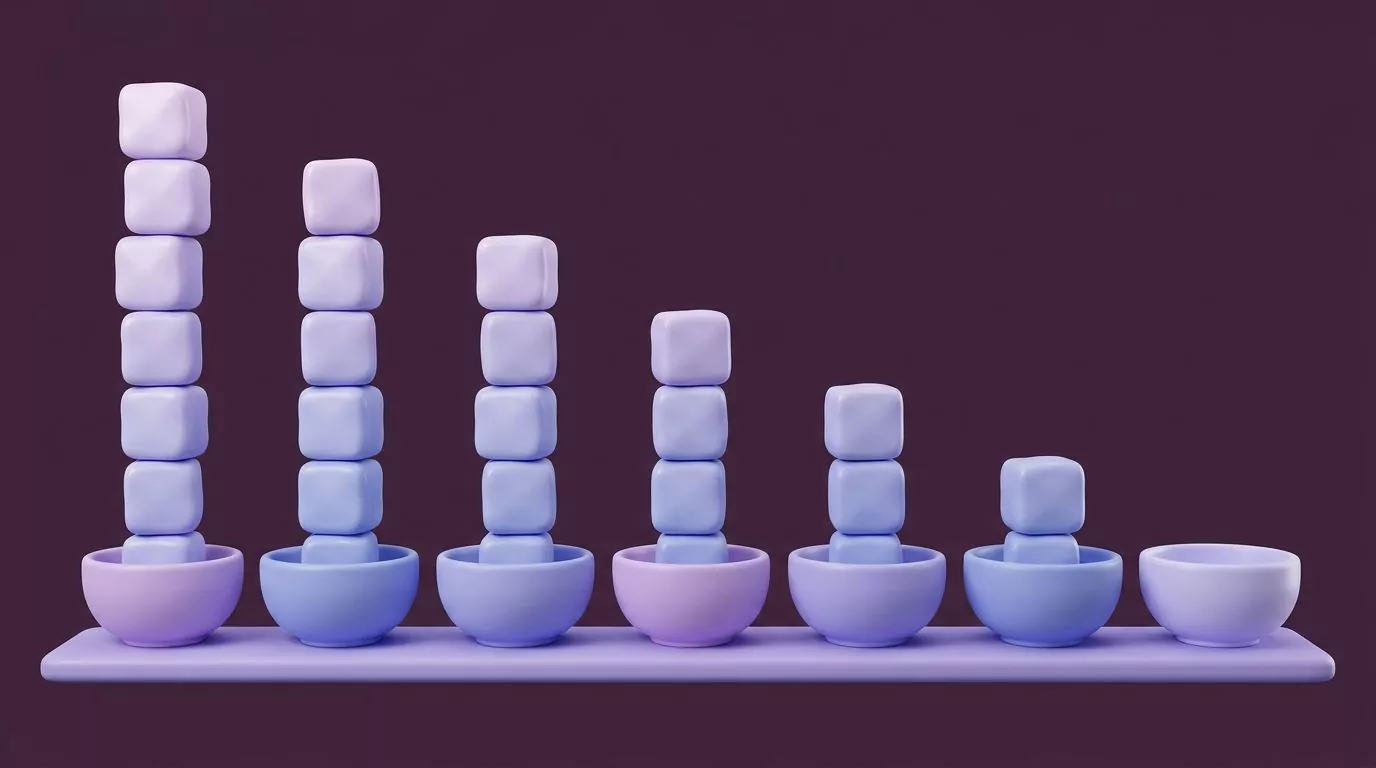
The good news is that the low end of the shelf is genuinely low. Several mainstream boxes carry no added sugar at all.
These cereals hold their numbers even when you pour a big bowl. When a box starts near zero, doubling the serving still leaves you near zero. That is the real test of a healthy low sugar cereal, and it is the one the front of the box never shows.
| Cereal | Label serving | Added sugar per serving | Added sugar per 100 g | Teaspoons in a 60 g bowl |
|---|---|---|---|---|
| Plain rolled oats | 1/2 cup dry (40 g) | 0 g | 0 g | 0 |
| Post Shredded Wheat Original | 2 biscuits (51 g) | 0 g | 0 g | 0 |
| Original Cheerios | 1 1/2 cups (39 g) | 1 g | 2.6 g | under 0.5 |
| Rice Chex | 1 1/3 cups (40 g) | 3 g | 7.5 g | 1.1 |
| Corn Chex | 1 1/4 cups (39 g) | 4 g | 10.3 g | 1.5 |
| Wheat Chex | 1 cup (59 g) | 6 g | 10.2 g | 1.5 |
Wheat Chex is worth a second look. Its label serving is 59 grams, which is close to a real bowl already.
That makes its 6 gram figure honest in a way the 36 gram servings are not. When a brand sets a bigger serving, the number on the panel is closer to what you will eat.
Plain oats are the floor
Rolled oats have one ingredient: oats. There is no added sugar to find, at any serving size.
The same is true of plain shredded wheat and plain puffed grains. If a cereal has no sweetener in the ingredient list, portion size stops mattering for sugar.
Kid cereal vs adult cereal: the comparison nobody makes
Kid cereals and adult cereals sit on the same shelf with very different numbers. The tricky part is that children have a smaller daily budget, not a larger one.
The American Heart Association recommends that children aged 2 to 18 keep added sugars under 25 grams a day, which is about 6 teaspoons. For children under 2, the recommendation is no added sugar at all.
The table below uses a 40 gram bowl, which is a realistic child sized pour. It is smaller than the 60 gram adult bowl used above.
| Box | Marketed to | Added sugar per 100 g | 40 g child bowl | Teaspoons | Share of a child's 25 g day |
|---|---|---|---|---|---|
| Kellogg's Honey Smacks | Children | 50.0 g | 20.0 g | 5.0 | 80% |
| Lucky Charms | Children | 33.3 g | 13.3 g | 3.3 | 53% |
| Froot Loops | Children | 30.8 g | 12.3 g | 3.1 | 49% |
| Cinnamon Toast Crunch | Children | 29.3 g | 11.7 g | 2.9 | 47% |
| Corn Chex | Family | 10.3 g | 4.1 g | 1.0 | 16% |
| Original Cheerios | Family | 2.6 g | about 1 g | 0.3 | 4% |
| Post Shredded Wheat | Adults | 0 g | 0 g | 0 | 0% |
Read the last column slowly. A small bowl of Smacks uses about four fifths of a child's whole day. A small bowl of Lucky Charms uses about half.
Context helps here. When the AHA published its children's guidance, it noted that US children were averaging about 19 teaspoons of added sugar a day against a 6 teaspoon recommendation. Breakfast is only one part of that gap, but it is the easiest part to see.
None of that means a box is off limits. It means breakfast can quietly spend most of the daily budget before school starts, and juice or a snack later has to fit in what is left.
The swap is not dramatic either. Moving from Lucky Charms to Corn Chex in the same 40 gram bowl saves about 9 grams of added sugar, or a little over 2 teaspoons.
If you want the limit for a specific age rather than the blanket 25 gram figure, the Kids Sugar Intake Calculator works it out from published guidance. It is awareness math, not medical advice, and a pediatrician is the right person for questions about a specific child.
The supermarket walkthrough: spot the sugar in 10 seconds
You do not need to memorize a high sugar cereals list. You need three habits that work on any box, including ones launched next year.

Step 1: read the Added Sugars line, not Total Sugars
Total Sugars includes sugar that came with the raisins or the milk powder. Added Sugars is the line that tracks sweetener put in during manufacturing.
The US Nutrition Facts panel has carried a separate Added Sugars line since the FDA required it. That single line does most of the work for you.
Step 2: check where sugar sits in the ingredient list
Ingredients are listed by weight, heaviest first. If a sweetener appears first or second, the box is mostly sweetener and grain in that order.
The catch is that sugar travels under many names. Cane syrup, dextrose, malt extract, brown rice syrup and fruit juice concentrate all count. Splitting one sweetener into three names pushes each one further down the list.
The Food Label Sugar Decoder translates those names into plain language, and the Hidden Sugar Finder highlights more than 70 of them inside any ingredient list you paste in.
Step 3: apply the USDA serving size rule
The USDA runs a simple threshold for cereals served in the Child and Adult Care Food Program. Every cereal must hold no more than 6 grams of added sugars per dry ounce.
Translated for shoppers, that means matching the serving size to a sugar cap. The USDA publishes the whole table, and these are the rows you will meet in the cereal aisle.
| If the label serving is | Added sugars should be no more than |
|---|---|
| 26 to 30 g | 6 g |
| 31 to 35 g | 7 g |
| 36 to 40 g | 8 g |
| 41 to 44 g | 9 g |
| 45 to 49 g | 10 g |
| 55 to 58 g | 12 g |
Run the six worst boxes through it and every one fails. Lucky Charms has a 36 gram serving, so the cap is 8 grams, and it carries 12.
Run the low sugar list through it and every one passes with room to spare. That is a useful test precisely because it ignores marketing.
To look up a cereal you already have at home, the Sugar in Food Checker lists sugar per serving, per 100 grams and in sugar cubes for a large set of foods.
Granola, muesli and the health halo problem
Granola looks like the grown up choice. Whether the numbers agree depends entirely on how you measure it.
Take Nature Valley Oats and Honey Protein Granola. A single 2/3 cup serving weighs 62 grams and carries 15 grams of added sugar out of 16 grams total.
Now run it through the same method as every box above. That works out to 24.2 grams of added sugar per 100 grams, and 14.5 grams in a weighed 60 gram bowl. Call it 3.6 teaspoons, or 58% of a 25 gram day.
The halo hides in the serving size, not the sugar density
Set those figures against the worst list. Those six boxes run from 29.3 grams per 100 grams up to 50.0, so this granola is less sweet by weight than every one of them. In an identical 60 gram bowl it lands below all six.
So why does the granola panel look so grim next to a kid cereal panel? Because its serving is 62 grams while the frosted boxes set theirs at 36 to 41 grams. The panel is measuring nearly twice as much cereal.
That is the trap from the top of this guide running in reverse. A bigger label serving makes a box look worse, a smaller one makes it look better, and the cereal inside the bag has not changed at all.
Why granola still wins by the scoop
Here is the catch, and it is the part the halo hides. Almost nobody weighs granola. People pour it by eye, and granola is much heavier than puffed loops for the same volume.
Do the density math. That granola runs about 93 grams per cup. Lucky Charms is 36 grams per cup, and Froot Loops is about 29 grams per cup.
Fill the same cup with each and the ranking flips. The granola brings about 22.5 grams of added sugar, or 5.6 teaspoons. The Lucky Charms brings about 12 grams, and the Froot Loops about 9 grams.
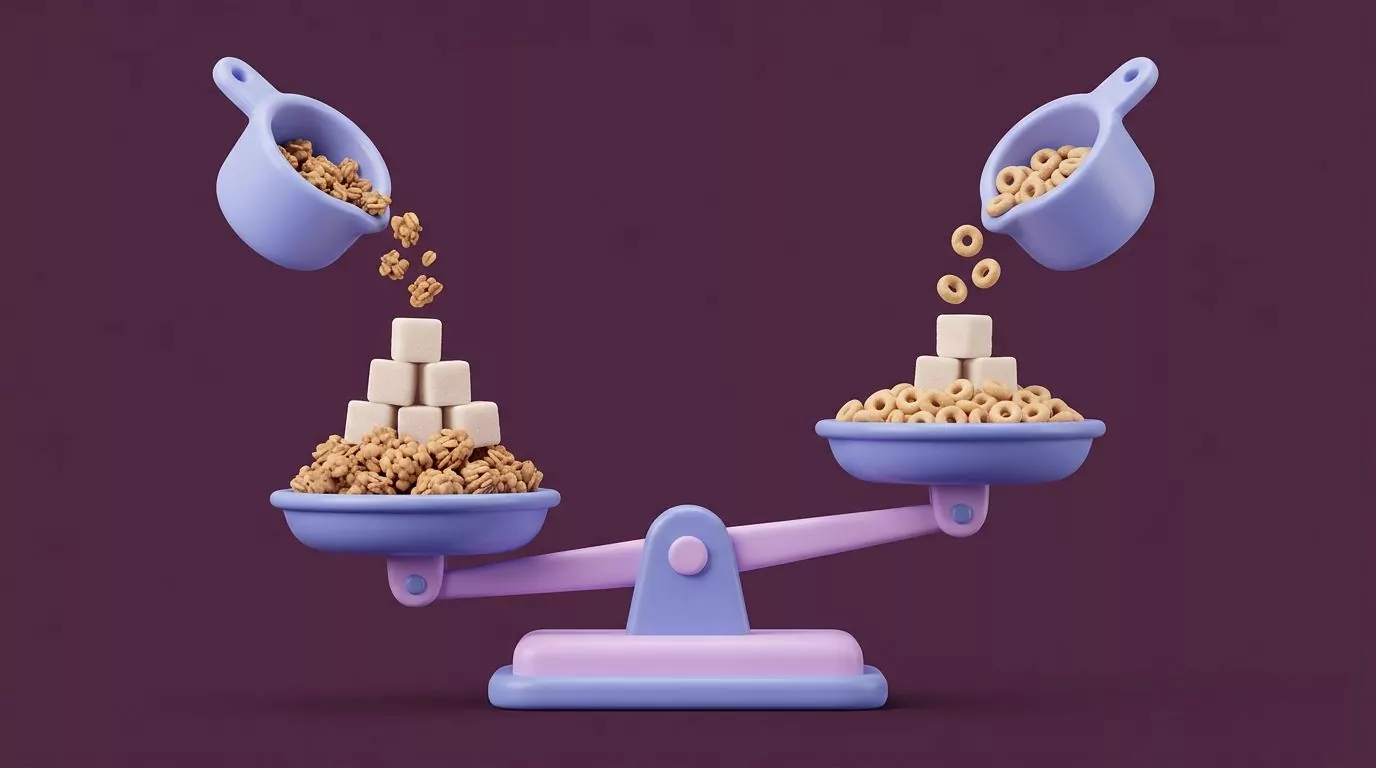
Two things build that density. Granola is baked with syrup or honey into clusters, so the sweetener is structural rather than a surface coating. Clusters also sit tightly in a bowl instead of trapping air the way loops and flakes do.
Muesli splits the difference. Traditional unsweetened muesli is oats, nuts and dried fruit with nothing added, so its Added Sugars line reads zero. Toasted and sweetened versions read much higher, and the two sit side by side on the shelf.
Other halo words worth checking
- Organic describes how the grain was farmed. It says nothing about the Added Sugars line.
- Whole grain tells you about the flour. A whole grain cereal can still be a third sugar by weight.
- No high fructose corn syrup often means the sweetener is cane sugar instead. The added sugar total can be identical.
- Made with real fruit usually points to fruit juice concentrate, which counts as added sugar on the panel.
- Protein on the front does not cap the sugar behind it, as the granola above shows.
Four ways to cut the number without banning a box
Swapping to plain shredded wheat overnight works for some households and fails in most. These four moves change the math without a fight at the table.
- Weigh one bowl, once. Put your normal pour on a kitchen scale a single time. Once you know your bowl is 58 grams rather than 36, every label on the shelf becomes readable at a glance.
- Cut the sweet box with a plain one. Half Lucky Charms and half Corn Chex in a 40 gram bowl lands near 8.7 grams of added sugar instead of 13.3. The color and the marshmallows survive, and the number drops by about a third.
- Move sweetness to the topping. Start from a zero sugar base like oats or shredded wheat, then add fruit or a measured teaspoon of honey. A level teaspoon is 4 grams, and you can see exactly what went in.
- Watch the second bowl. Refills rarely get counted, yet a second pour doubles everything in the tables above. Deciding on the amount before you sit down beats deciding while you eat.
None of these require a new shopping list. They work on the boxes already in the cupboard, which is why they tend to stick.
Cereal is also worth keeping in proportion. It is one meal, and a bowl of frosted flakes is not an emergency. The value of the numbers above is that they let you spend your daily sugar budget on purpose rather than by accident.
Frequently Asked Questions
How much sugar in cereal is too much?
A practical cutoff is the USDA rule of about 6 grams of added sugar per 30 gram serving. Below that, a normal bowl stays near 1 to 2 teaspoons. Above roughly 10 grams per serving, one real bowl starts eating a large share of a 25 gram daily limit.
Which cereal has the most sugar?
Among mainstream US boxes we checked, Kellogg's Honey Smacks is the highest at 50 grams of added sugar per 100 grams. That is half the box by weight. A 60 gram bowl carries about 30 grams, or 7.5 teaspoons.
Which cereals have no added sugar?
Plain rolled oats, plain shredded wheat, plain puffed rice and puffed wheat, and unsweetened muesli all read 0 grams on the Added Sugars line. Original Cheerios is close behind at 1 gram per serving. Check the panel, since brands reformulate.
Is granola higher in sugar than regular cereal?
It depends on how you measure. By weight, a popular protein granola runs 24.2 grams of added sugar per 100 grams, which is below every frosted box in the table above. By the scoop it flips, because granola is about two and a half times denser, so the same cup holds far more cereal and far more sugar.
How many teaspoons of sugar are in a bowl of frosted cereal?
About 4.5 to 5 teaspoons for a 60 gram bowl. Frosted Flakes works out to 19.4 grams of added sugar in that bowl, which is 4.9 teaspoons. The label serving of 37 grams shows 12 grams instead, or 3 teaspoons.
The one number worth knowing
Pick up your usual box tomorrow and do one calculation. Divide the added sugars by the serving size, multiply by 60, then divide by 4.
That teaspoon figure is the honest version of your breakfast. Most people find it is one to two teaspoons higher than they expected.
If you want your own daily target rather than a generic 25 grams, the Daily Sugar Intake Calculator turns your calorie needs into a personal limit in grams and teaspoons, using WHO and AHA guidance. It takes about a minute and runs in the browser. Sugar Lens, the added sugar tracking app built around the same limits, is in development for iOS.
Numbers on this page come from Nutrition Facts panels and USDA FoodData Central records current at the time of writing. Recipes change, so the box in your hand is always the final word.