How to Keep a Food Journal You'll Actually Stick With: 6 Steps and a Weekly Review
A food journal is a running record of what you eat and drink. To keep one you won't quit, log right after eating, record only the detail you'll use, such as added sugar in grams, and spend about ten minutes a week on totals and top sources. Keep a fuller diary if a clinician asks.
What a food journal is, and why "food diary" and "food log" mean the same thing
Food journal, food diary and food log all describe one habit: writing down what you ate and drank. The words are interchangeable.
The point is not judgment. It is pattern spotting. A week of entries shows where your snacking, your drinks or your added sugar in grams really come from. One line, chosen on purpose, beats six fields you abandon on day four.
What the self-monitoring research actually shows
Burke, Wang and Sevick reviewed 22 studies from 1993 to 2009 in the Journal of the American Dietetic Association. They found a steady link between logging and weight loss, and rated the evidence weak because of limits in the studies.
Harvey and colleagues asked how often people logged. In a 24-week online program with 142 people, published in Obesity in 2019, those who lost at least 5 percent of their weight opened their journal more times a day. Time spent did not.
Both are associations, not promises. The everyday benefit is simpler: you find out what you are actually eating.
Why people quit a detailed food diary
Cordeiro and colleagues studied the quitting in a 2015 CHI paper, surveying 141 current and lapsed food journalers and 5,526 posts from app forums.
"Too much effort" turned out to be four separate barriers: working out what and how much to enter, databases missing items or plainly wrong, eating out where you did not cook, and losing the habit after one missed entry. It also describes people coming to feel judged or obsessive.
Every one of those shrinks when an entry has fewer fields.
What to record: the minimal version against the detailed version
More detail means more work per entry, and that is what people quit.

The one-line journal: one number you want to change
The smallest journal that works records one number per entry. If added sugar is your line, write the grams and nothing else.
Then hold the day against a limit. The American Heart Association advises about 25 g a day for women (6 teaspoons) and 36 g for men (9 teaspoons). The World Health Organization puts free sugars below 10 percent of daily energy, ideally below 5 percent, roughly 25 g at 2,000 calories.
WHO free sugars also count the sugar in fruit juice, honey and syrups, so 100 percent juice goes into your total.
| What you're looking at | What it tells you | Where to check |
|---|---|---|
| US Nutrition Facts label | Added Sugars in grams per serving, under Total Sugars | FDA guide to Added Sugars |
| UK or EU label | Total sugars only, including sugar from milk and fruit, so it can overstate added sugar | Food Label Sugar Decoder and the NHS label guide |
| Ingredient list | Which sugars were added, not how much of each | Hidden Sugar Finder, for the 90 names sugar hides behind |
| Everyday food with no label | A sugar figure per serving and per 100 g | Sugar in Food Checker, covering 130 foods |
The detailed journal: food, amount, time, place, company, mood
The full version comes from familydoctor.org, published by the American Academy of Family Physicians: how much, what kind, the time, where you were, who you were with, what else you were doing, and how you felt. Harvard Health asks for much the same.
familydoctor.org's four rules are the part worth copying: write everything down however small, do it now rather than at bedtime, be specific so a coffee is a size and a milk, and estimate amounts, using a deck of cards for a 3 ounce portion.
The American Society for Nutrition frames it as mindful eating: noticing what, how, why and when you eat.
It suits a short stint. familydoctor.org suggests at least 3 to 4 days before a visit, and symptom notes belong with a registered dietitian, not with your own diagnosis.
Side by side: one illustrative day, logged both ways
| Entry | Detailed journal | One-line journal |
|---|---|---|
| Breakfast | Cereal with yogurt, 1 bowl, 7:40 am, kitchen, alone, rushed | 12 g |
| Coffee | Latte with one sugar, 9:15 am, office, with a colleague, fine | 4 g |
| Lunch | Sandwich and a cola, 1:10 pm, desk, alone, distracted | 35 g |
| Snack | Two biscuits, 4 pm, office kitchen, with colleagues, bored | 9 g |
| Dinner | Pasta with jarred sauce, 7:30 pm, table, with family, relaxed | 8 g |
The day above is illustrative. Six fields per entry on the left, one on the right, and both point at the cola at lunch. If your mornings look similar, check the sugar in breakfast cereal.
Paper, app, or photo: pick the format you'll open tomorrow
Formats differ mostly in how many fields they ask for. Pick the one you will actually open tomorrow.
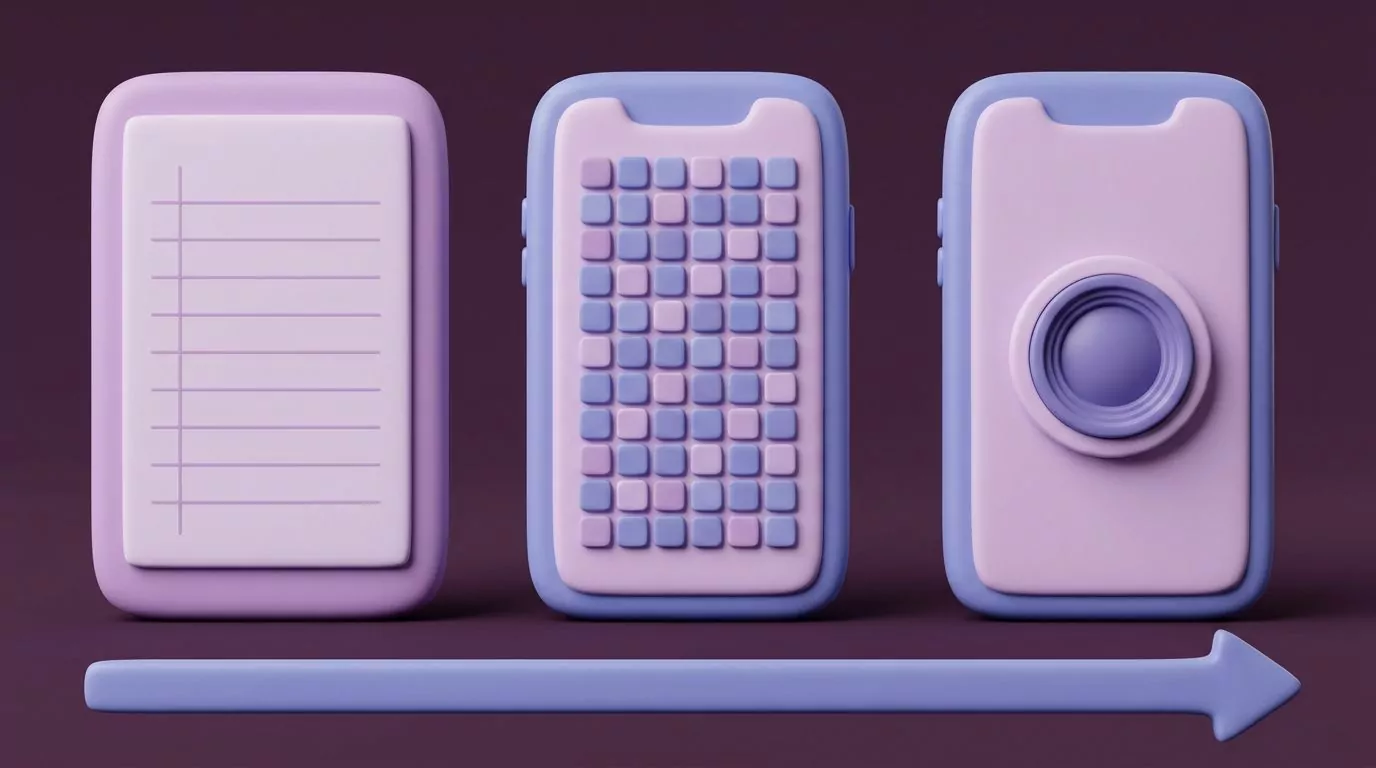
Paper or a printable log
A notebook needs no phone and no account, and never sends a notification. The Free Printable Sugar Log gives you daily detailed pages or a weekly grid, with your own daily limit printed on the sheet.
Full nutrition apps
General nutrition apps carry large databases and many fields per entry: portions, calories, protein, fat, carbs. That is a fuller picture at week's end, and more chances to skip a day.
Photo-first logging
Photo logging swaps typing for a camera. Sugar Tracker: Food Scanner, the Sugar Lens app, is free on the App Store for iPhone: photograph your food, it estimates the added sugar in grams, and you review and confirm every entry before it saves. Manual logging covers amounts you already know, and your log stays on the device.
How to keep a food journal in 6 steps

- Choose one-line or detailed. One number per entry if you want this to last, the full field list if a clinician asked for it.
- Find your real number, then set a target. The How Much Sugar Do You Eat? quiz estimates your daily added sugar from 10 questions about everyday habits, against the WHO limits and the US average. The Daily Sugar Intake Calculator turns your calorie needs into a personal limit, and how much sugar per day explains it. With a condition, use your clinician's numbers.
- Log right after eating. The entry you write at bedtime is the one you round down. Stack it onto something you already do, like waiting for the kettle.
- Include drinks. They are easy to forget and often the biggest source. The Sugar in Drinks Calculator totals a day of them, and cutting back on soda is where many numbers move first.
- Log the high days too. A journal with the bad days missing is a highlight reel.
- Review once a week. Entries without a review are just a list.
The 10-minute weekly review that turns entries into a pattern
Once a week, set aside about ten minutes and read back over your entries. This is you reading your week, not a feature you switch on.
The four questions to ask your week
- What was my daily average, against my limit? Add the seven days, divide by seven.
- What were my top three sources? The biggest single entries, not the most frequent.
- How many days went over? Two is a week. Six is a routine.
- Was the worst day a one-off or a pattern? A birthday is an off day. Every Friday is a pattern.
Kept the detailed version? Add a fifth: which times, places, company or moods keep turning up next to the big entries?
An example week, reviewed

This week is illustrative. Teaspoons come from the Sugar Grams to Teaspoons Converter, at 4.2 g each.
| Day | Added sugar | Biggest source |
|---|---|---|
| Monday | 68 g, about 16 tsp | Cola at lunch, 35 g |
| Tuesday | 41 g, about 10 tsp | Flavoured yogurt, 18 g |
| Wednesday | 74 g, about 18 tsp | Dessert, 30 g |
| Thursday | 22 g, about 5 tsp | Two biscuits, 9 g |
| Friday | 96 g, about 23 tsp | Drinks out, 48 g |
| Saturday | 55 g, about 13 tsp | Ice cream, 24 g |
| Sunday | 30 g, about 7 tsp | Cereal, 12 g |
The average is 55 g a day: more than double the AHA's 25 g for women, and about half again over the 36 g for men. Five of the seven days sit above 36 g, and two of the top three sources are liquid.
Friday reads as a pattern, so change one thing there and keep the rest the same. The Sugar Swap Finder shows the grams a swap saves. If the same 4 pm entry keeps reappearing, that is probably a craving rather than hunger, and there are practical ways to stop craving sugar.
If tracking starts to feel stressful, it's fine to stop
A food journal is a tool, not a test you can fail. If logging starts to feel like scoring yourself, put it down.
If you have a history of disordered eating, speak to a registered dietitian before you start tracking.
Frequently Asked Questions
How long should I keep a food journal?
There is no set duration. familydoctor.org suggests a complete food diary for at least 3 to 4 days before a doctor's visit. A one-line journal can run for weeks.
Do I need to weigh or measure food for a food journal?
Usually not. familydoctor.org recommends comparisons such as a deck of cards for a 3 ounce portion. Estimates are enough for spotting patterns.
If I miss a day of logging, what then?
Log the next meal and move on. Missed entries are one of the four barriers Cordeiro and colleagues found behind quitting. Average the days you did log.
What's the difference between a food journal and calorie counting?
Calorie counting records energy, and only energy. A food journal tracks any line you choose: added sugar, vegetables, drinks, or how you felt.
Can a food journal help spot food sensitivities?
It pairs what you ate with the symptoms that followed, which is useful to hand over. It diagnoses nothing, so take the pages to a dietitian.
This article is general information, not medical advice, and it follows WHO, AHA and NHS guidance. If you have diabetes or another condition, use your clinician's numbers.
If added sugar is your line, Sugar Tracker: Food Scanner is free on the App Store for iPhone: photograph the meal, confirm the estimate, and see your day against the WHO and AHA limits. Prefer paper? Print a week of sheets and start tomorrow.